
Ambient Air Quality Monitoring System (AQMS): Complete Guide
Learn everything about Ambient Air Quality Monitoring Systems (AQMS), AQI Monitoring Machines, air quality sensors, PM2.5 & PM10 monitoring, working principles, applications, specifications, FAQs, and why TRP Machines & Tools provides reliable environmental monitoring solutions.
REV A
01Overview
Air pollution has become one of the most significant environmental challenges affecting cities, industries, construction projects, highways, mining operations, and urban infrastructure. Monitoring air quality is essential for protecting public health, ensuring environmental compliance, and supporting pollution control initiatives.
An Ambient Air Quality Monitoring System (AQMS) is an advanced environmental monitoring solution designed to continuously measure air pollutants, particulate matter, and meteorological parameters in real time. It helps industries, government agencies, construction companies, municipal corporations, and research organizations monitor pollution levels and take timely corrective actions.
Also known as an AQI Monitoring Machine, Outdoor Air Quality Monitor, Air Pollution Monitoring System, Environmental Monitoring Station, Continuous Ambient Air Quality Monitoring System (CAAQMS), PM2.5 Monitor, PM10 Monitoring Station, or Air Quality Monitoring Station, this system plays a critical role in maintaining cleaner and healthier environments.
TRP Machines & Tools, Mumbai, Maharashtra, India, supplies advanced Ambient Air Quality Monitoring Systems designed for accurate, reliable, and continuous monitoring of environmental air quality across various industries.
02Quick Answer
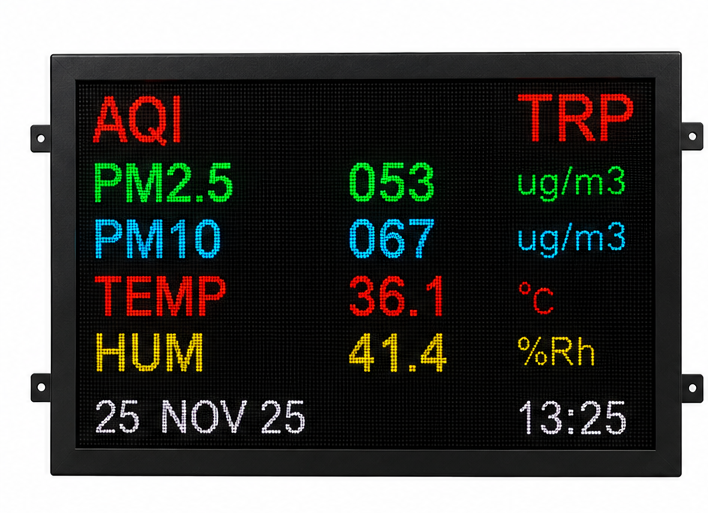
An Ambient Air Quality Monitoring System (AQMS) is an advanced environmental monitoring station that continuously measures air pollutants such as PM2.5, PM10, CO, SO₂, NO₂, O₃, CO₂, VOCs, along with weather parameters like temperature, humidity, wind speed, wind direction, rainfall, and atmospheric pressure to calculate the Air Quality Index (AQI) in real time.
03What is an Ambient Air Quality Monitoring System?
An Ambient Air Quality Monitoring System (AQMS) is an automated station that continuously monitors the concentration of pollutants present in outdoor air.
It collects environmental data 24 hours a day and provides real-time information regarding air quality conditions. The collected data can be displayed locally, transmitted to cloud platforms, integrated with pollution control authorities, or used for environmental reporting.
AQMS enables organizations to monitor pollution trends, identify pollution sources, evaluate mitigation measures, and comply with environmental regulations.
04What is AQI (Air Quality Index)?
The Air Quality Index (AQI) is a numerical value that indicates how clean or polluted the air is.
AQI converts measurements of multiple pollutants into a single, easy-to-understand index that helps determine the health impact of air quality.
A lower AQI indicates cleaner air, while a higher AQI indicates increasing levels of pollution and greater health risks.
AQI is widely used by:
- Government agencies
- Municipal corporations
- Construction companies
- Environmental consultants
- Industries
- Schools
- Hospitals
- Public information displays
05Why is Air Quality Monitoring Important?
Continuous air quality monitoring helps organizations:
- Monitor pollution levels
- Protect public health
- Improve workplace safety
- Support environmental compliance
- Evaluate pollution control measures
- Identify pollution sources
- Generate environmental reports
- Improve sustainability initiatives
06How Does an Ambient Air Quality Monitoring System Work?
AQMS uses multiple high-precision sensors to continuously monitor environmental conditions.
- 01Air SamplingAmbient air enters the monitoring chamber through the sampling inlet.
- 02Pollutant DetectionDedicated sensors measure various gases and particulate matter concentrations.
- 03Weather MonitoringMeteorological sensors record temperature, humidity, wind speed, wind direction, rainfall, solar radiation, and atmospheric pressure.
- 04Data ProcessingThe controller processes sensor data and calculates the Air Quality Index (AQI).
- 05Real-Time DisplayThe data is displayed on the integrated display screen and transmitted to cloud servers or monitoring software.
- 06ReportingHistorical reports, trends, alerts, and environmental analysis are generated for decision-making.
07Parameters Measured by AQMS
Depending on the model, an Ambient Air Quality Monitoring System can monitor:
08Particulate Matter
- PM1
- PM2.5
- PM10
- Total Suspended Particles (TSP)
09Gaseous Pollutants
- Carbon Monoxide (CO)
- Carbon Dioxide (CO₂)
- Sulphur Dioxide (SO₂)
- Nitrogen Dioxide (NO₂)
- Nitric Oxide (NO)
- Ozone (O₃)
- Ammonia (NH₃)
- Hydrogen Sulphide (H₂S)
- Volatile Organic Compounds (VOC)
10PM2.5
Particles smaller than 2.5 microns.
Can penetrate deep into the lungs and bloodstream, posing significant health risks.
11PM10
Particles smaller than 10 microns.
Typically generated from construction, road dust, mining, crushing, and industrial operations.
Monitoring both PM2.5 and PM10 is essential for effective pollution control.
12Meteorological Monitoring
Many AQMS stations also monitor weather parameters, including:
- Temperature
- Relative Humidity
- Wind Speed
- Wind Direction
- Rainfall
- Atmospheric Pressure
- Solar Radiation
- Noise Level (Optional)
These parameters help understand pollution dispersion and environmental conditions.
13Key Features
- Continuous 24×7 monitoring
- Real-time AQI calculation
- High-accuracy sensors
- PM2.5 & PM10 monitoring
- Multi-gas monitoring
- Weather station integration
- Digital display
- Data logging
- Cloud connectivity
- Remote monitoring
- Automatic alerts
- Low maintenance
- Modular design
- Rugged outdoor enclosure
- Long service life
14Environmental Benefits
- Better pollution control
- Improved environmental management
- Supports sustainability goals
- Helps reduce air pollution
15Operational Benefits
- Real-time monitoring
- Automatic reporting
- Early pollution detection
- Continuous operation
- Reliable environmental data
16Regulatory Benefits
- Supports environmental compliance
- Simplifies regulatory reporting
- Improves environmental auditing
- Helps meet pollution monitoring requirements
17Technical Specifications
- Machine Type: Ambient Air Quality Monitoring System (AQMS)
- Application: Outdoor Air Quality Monitoring
- Monitoring Type: Continuous Real-Time Monitoring
- Parameters: PM2.5, PM10, Gases & Weather Parameters
- Display: Digital LCD / LED
- Connectivity: Cloud / GSM / Ethernet / Wi-Fi (Model Dependent)
- Power Supply: AC Power with Optional Solar Backup
- Data Storage: Internal & Cloud-Based
- Installation: Pole Mounted / Ground Mounted
- Enclosure: Weatherproof Outdoor Cabinet
- Maintenance: Low
18Ambient Air Quality Monitoring System
- Continuous monitoring
- Real-time data
- Automatic AQI calculation
- Remote monitoring
- Data logging
- Automatic alerts
- High accuracy
- Minimal manual intervention
19Manual Air Monitoring
- Periodic sampling
- Delayed results
- Labour intensive
- Limited historical data
- Manual reporting
- Lower monitoring frequency
20Applications
Ambient Air Quality Monitoring Systems are widely used in:
- Construction Sites
- Smart City Projects
- Industrial Plants
- Manufacturing Facilities
- Cement Plants
- Mining Projects
- Stone Crushers
- Highways
- Metro Rail Projects
- Railway Stations
- Airports
- Ports
- Power Plants
- Residential Townships
- Schools
- Universities
- Hospitals
- Municipal Corporations
- Environmental Monitoring Agencies
- Government Projects
21Industries Served
- Environmental Monitoring
- Construction Industry
- Infrastructure Development
- Mining Industry
- Cement Industry
- Manufacturing Industry
- Government Agencies
- Municipal Corporations
- Smart City Projects
- EPC Contractors
- Educational Institutions
- Research Organizations
22Maintenance Tips
- Clean particulate sensors regularly.
- Calibrate gas sensors as recommended.
- Inspect sampling inlets.
- Check weather sensors periodically.
- Verify communication modules.
- Update firmware when required.
- Maintain backup power systems.
23Buying Guide
Before purchasing an AQMS, consider:
- Number of pollutants to monitor
- Sensor technology
- AQI calculation capability
- Data logging capacity
- Cloud integration
- Display visibility
- Calibration requirements
- Weather monitoring options
- Service support
- Compliance requirements
24Why Choose TRP Machines & Tools?
TRP Machines & Tools offers advanced Ambient Air Quality Monitoring Systems engineered for accurate environmental monitoring and reliable long-term performance.
25Why Customers Choose TRP Machines & Tools
- High-accuracy sensor technology
- Real-time AQI monitoring
- Modular system design
- Weatherproof construction
- Cloud-enabled monitoring
- Low maintenance
- Long service life
- Competitive pricing
- Pan India supply
- Technical support
- Trusted by contractors, industries, consultants, and government organizations
26Frequently Asked Questions
What is an Ambient Air Quality Monitoring System?
It is a real-time environmental monitoring station that continuously measures air pollutants and calculates the Air Quality Index (AQI).
What pollutants can an AQMS monitor?
It can monitor PM2.5, PM10, CO, SO₂, NO₂, O₃, CO₂, VOCs, NH₃, H₂S, and other pollutants depending on the configuration.
Where is an AQMS installed?
AQMS is installed at construction sites, industrial plants, highways, smart cities, mining projects, schools, hospitals, airports, ports, and government monitoring stations.
Does an AQMS provide real-time data?
Yes. Modern AQMS continuously monitors air quality and provides live data through displays, software dashboards, and cloud platforms.
Why is AQI important?
AQI provides an easy-to-understand indication of current air quality, helping organizations and the public understand pollution levels and associated health risks.
27Conclusion
An Ambient Air Quality Monitoring System (AQMS) is an essential environmental monitoring solution for modern industries, infrastructure projects, and urban developments. By continuously measuring pollutants and meteorological conditions, it enables informed decision-making, regulatory compliance, and improved public health.
Whether you need to monitor construction sites, industrial facilities, smart cities, mining operations, or municipal infrastructure, TRP Machines & Tools provides reliable AQMS solutions engineered for accuracy, durability, and continuous real-time environmental monitoring.
Ambient Air Quality Monitoring System
- AQMS
- AQI Monitoring Machine
- Outdoor Air Quality Monitor
- Air Quality Monitoring Station
- Continuous Ambient Air Quality Monitoring System
- Environmental Monitoring System
- Air Pollution Monitoring System
- PM2.5 Monitor
- PM10 Monitoring Station
- Outdoor AQI Monitor
- Best Ambient Air Quality Monitoring System in India
- AQI Monitoring Machine for Construction Sites
- Outdoor Air Quality Monitoring System
- PM2.5 and PM10 Monitoring Machine
- Continuous Ambient Air Quality Monitoring System Supplier
- Industrial Air Quality Monitoring Station
- Smart City Air Quality Monitoring Solution
- Environmental Monitoring Equipment Manufacturer
- Air Pollution Monitoring Machine India
- AQMS Supplier for Infrastructure Projects