

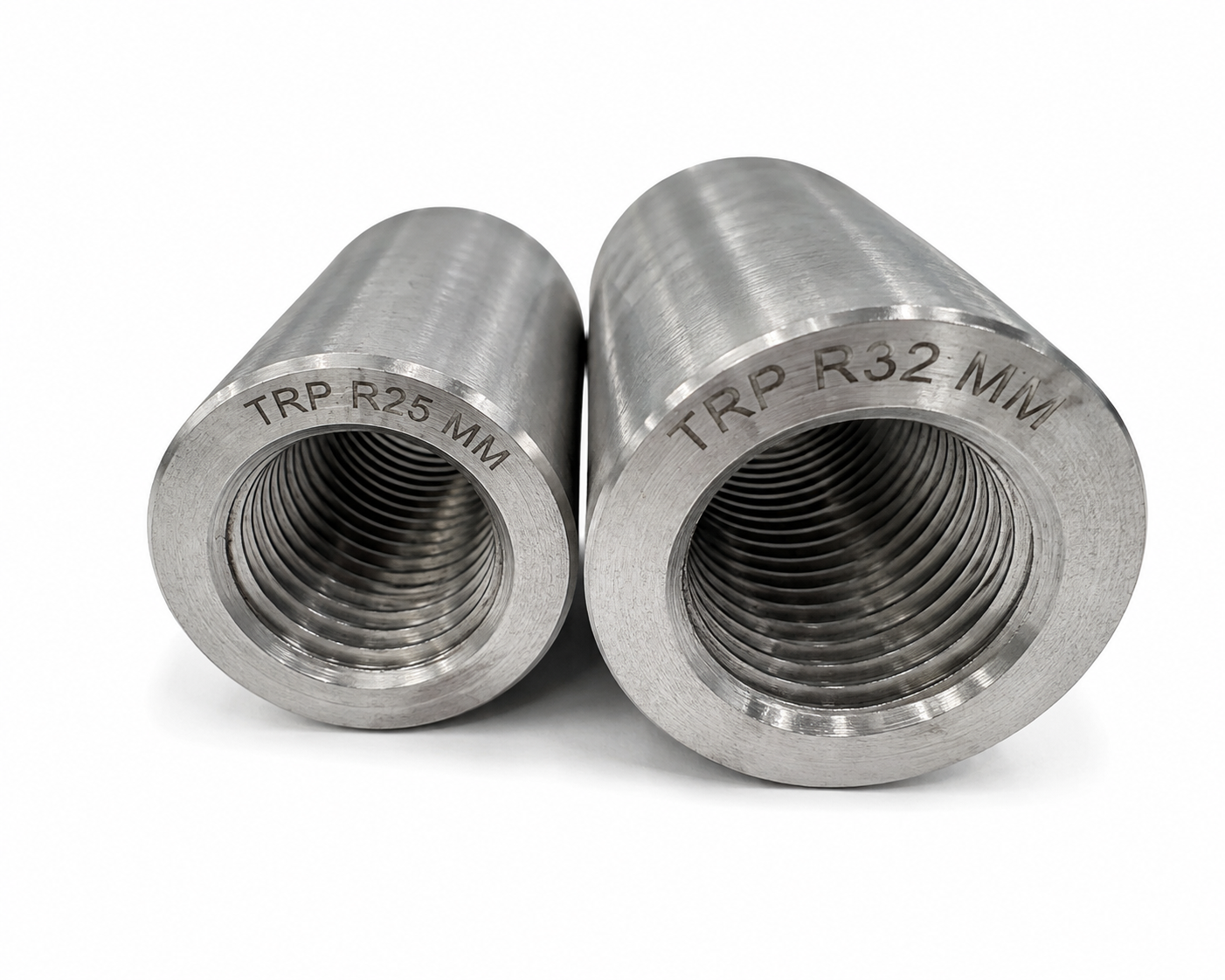
What Is a Rebar Coupler?
A rebar coupler is a mechanical connector used to join two reinforcement bars (rebars) in reinforced concrete structures. It provides a connection between reinforcing bars without requiring the conventional overlapping length used in lap splicing.
Also known as a mechanical rebar coupler, reinforcement coupler or TMT bar coupler, this component is used in construction projects where reinforcement continuity, connection requirements and efficient reinforcement arrangement are important.
In conventional reinforced concrete construction, reinforcement bars are often joined through lap splicing. However, as structural designs become more demanding and reinforcement arrangements become congested, mechanical splicing systems are increasingly considered for suitable applications.
A rebar coupler provides an alternative connection method, subject to structural design requirements, product specifications and applicable standards.
From residential buildings and commercial structures to bridges, flyovers, metro projects and industrial infrastructure, rebar couplers are used across different types of reinforced concrete construction.
But not every rebar coupler works in the same way. Different projects require different connection methods, bar sizes and installation arrangements.
Understanding these differences is essential before selecting a rebar coupler for a construction project.
Why Are Rebar Couplers Used in Construction?
Reinforcement plays an important role in the strength and structural performance of reinforced concrete. The method used to connect reinforcement bars must therefore meet the requirements of the structural design.
Rebar couplers are used where a mechanical connection is specified or considered suitable.
Some important reasons for using rebar couplers include:
1. Reduced Reinforcement Congestion
In heavily reinforced structural members, overlapping reinforcement bars can create congestion.
Mechanical rebar couplers can eliminate the conventional lap length at the connection, helping create a more organised reinforcement arrangement.
This can be particularly useful in columns, walls, beams and other reinforced concrete elements where reinforcement density is high.
2. More Efficient Use of Reinforcement Steel
Lap splicing requires additional reinforcement length for the specified overlap.
A mechanical rebar coupler connects bars through a mechanical connection, which may reduce the additional reinforcement steel required for lap lengths.
The actual material savings depend on the structural design, bar arrangement, coupler dimensions and project requirements.
3. Suitable for Different Construction Applications
Rebar couplers are available in different designs and connection methods.
Depending on the system, they can be considered for applications involving conventional threaded connections, restricted bar rotation, different bar diameters and other specific reinforcement requirements.
4. Better Reinforcement Planning
Mechanical splicing can support planned reinforcement arrangements, particularly in projects where structural members contain a large number of reinforcing bars.
The appropriate coupler system should be selected during the design and construction planning stage.
5. Mechanical Connection Between Reinforcement Bars
A properly selected and installed rebar coupler provides a mechanical connection between reinforcement bars.
Its performance must be verified against the specified structural requirements through appropriate technical documentation and testing.
Types of Rebar Couplers Used in Construction
Different rebar coupler types are designed for different reinforcement connection requirements.
The selection depends on the bar diameter, connection method, site conditions, installation process and project specifications.
1. Standard Threaded Rebar Coupler
A standard threaded rebar coupler connects two reinforcement bars through matching threads prepared at their ends.
The bars are processed according to the specified threading system, and the coupler joins the two threaded ends.
Applications:
- Reinforced concrete buildings.
- Columns and beams.
- Infrastructure projects.
- General mechanical reinforcement splicing.
2. Parallel Thread Rebar Coupler
A parallel thread rebar coupler uses parallel threads on the reinforcement bar ends to establish a mechanical connection.
The thread dimensions and preparation process must be compatible with the selected coupler.
Applications:
- Structural reinforcement connections.
- High-rise building construction.
- Projects using compatible threaded reinforcement systems.
3. MBT Rebar Coupler
An MBT-type rebar coupler uses a mechanical bolting arrangement to connect reinforcement bars.
Unlike conventional threaded couplers, this type of system is designed around a different mechanical connection arrangement. Certain designs can be used without preparing conventional threads on the reinforcement bar ends.
Applications:
- Reinforcement connections where conventional threading is not suitable.
- Repair and extension applications, where approved by the structural design.
- Restricted installation situations.
- Projects requiring a compatible bolted connection system.
4. One Touch Rebar Coupler
A One Touch rebar coupler is designed to simplify the reinforcement connection process through its specific connection mechanism.
The actual installation method and compatibility depend on the product design.
Applications:
- Construction projects requiring a compatible quick-connection arrangement.
- Reinforcement installation where the specified connection system supports simplified handling.
5. Push Fit Rebar Coupler
A push-fit rebar coupler is designed around a push-fit connection mechanism.
The coupler type, bar-end configuration and installation procedure must be checked before use.
Applications:
- Suitable reinforcement connection arrangements.
- Projects where the selected push-fit system meets the structural requirements.
6. Reducer Rebar Coupler
A reducer rebar coupler is used to connect two reinforcement bars of different diameters.
For example, a project may require a connection between a larger reinforcement bar and a smaller reinforcement bar. A compatible reducer coupler is designed for the specified diameter combination.
Applications:
- Structural reinforcement transitions.
- Connections between different bar sizes.
- Projects with changing reinforcement requirements.
7. Position Rebar Coupler
A position coupler is designed for situations where the reinforcement bars cannot be rotated freely during installation.
Its connection arrangement allows the bars to be connected according to the specific system's installation procedure.
Applications:
- Restricted reinforcement positions.
- Reinforcement cages.
- Structural members with limited bar movement.
Rebar Coupler Applications in Different Construction Projects
Rebar couplers are used in several reinforced concrete applications where mechanical reinforcement connections are suitable.
Rebar Coupler for High-Rise Buildings
High-rise buildings often involve heavily reinforced columns, shear walls and structural members.
Mechanical rebar couplers can help reduce lap-related reinforcement congestion and support planned reinforcement arrangements.
Rebar Coupler for Bridges and Flyovers
Bridge and flyover construction involves reinforced concrete components that may require carefully designed reinforcement connections.
Suitable mechanical couplers can be considered for specified reinforcement splicing applications.
Rebar Coupler for Metro and Infrastructure Projects
Metro stations, tunnels, elevated structures and other infrastructure projects can involve extensive reinforcement work.
Mechanical rebar couplers may be specified to meet particular reinforcement connection and construction requirements.
Rebar Coupler for Industrial Structures
Industrial buildings, foundations and other reinforced concrete structures may require mechanical reinforcement connections depending on their structural design.
Rebar Coupler for Residential and Commercial Construction
Rebar couplers can also be used in residential and commercial projects where specified by the structural engineer.
Their suitability depends on the reinforcement arrangement, project requirements and connection design.
Rebar Coupler vs Lap Splicing: Understanding the Difference
Both mechanical rebar couplers and lap splicing are methods used to connect reinforcement bars.
However, their connection mechanisms are different.
Rebar Coupler vs Lap Splicing
1. Connection Method
- Rebar Coupler: Uses a mechanical connector to join reinforcement bars.
- Lap Splicing: Connects reinforcement bars through overlapping lengths.
2. Bar Overlap
- Rebar Coupler: Conventional lap length is not required.
- Lap Splicing: Requires a specified overlap length.
3. Reinforcement Congestion
- Rebar Coupler: Can help reduce reinforcement congestion.
- Lap Splicing: May increase congestion due to overlapping bars.
4. Steel Requirement
- Rebar Coupler: May reduce additional reinforcement steel required for lap lengths.
- Lap Splicing: Requires additional reinforcement length for the specified lap.
5. Installation
- Rebar Coupler: Installation depends on the coupler design and manufacturer's procedure.
- Lap Splicing: Requires correct overlap length and reinforcement placement.
6. Quality Checks
- Rebar Coupler: Requires coupler-specific and connection-specific inspections.
- Lap Splicing: Requires checking lap length and reinforcement placement.
Rebar Coupler Installation: How Does It Work?
The installation process depends on the type of rebar coupler selected.
For a conventional threaded rebar coupler, the general process includes the following stages.
Step 1: Reinforcement Bar Preparation
The reinforcement bars are cut and prepared according to the requirements of the selected coupling system.
Step 2: Bar-End Processing
The bar ends undergo the required preparation process. Depending on the system, this may involve cold forging or another specified preparation method.
Step 3: Rebar Threading
For threaded couplers, the prepared bar ends are threaded using compatible rebar threading machinery.
Step 4: Thread Inspection
The prepared threads are checked for dimensions, condition and compatibility with the selected coupler.
Step 5: Coupler Fitting
The rebar coupler is fitted according to the manufacturer's installation instructions.
Step 6: Final Connection Inspection
The completed connection is inspected for correct engagement, alignment and the specified installation requirements.
MBT, push-fit and other coupler designs can have different installation processes. Their respective manufacturer instructions must be followed.
Rebar Coupler Specifications: What Should You Check?
Before selecting or purchasing a rebar coupler, it is important to verify the technical specifications.
The following information helps identify a suitable product.
Rebar Coupler Specifications: What Should You Check?
Before purchasing a rebar coupler, verify the following technical specifications:
1. Rebar Diameter: Confirm compatibility with the required reinforcement bar sizes.
2. Bar Grade: Check compatibility with the reinforcement steel grade.
3. Coupler Type: Identify whether you require a threaded, MBT, reducer, push-fit or another coupler design.
4. Material: Verify the product material and applicable material grade.
5. Dimensions: Check the coupler length, outer diameter and other relevant measurements.
6. Thread Details: For threaded couplers, verify thread type, pitch and dimensions.
7. Mechanical Performance: Review applicable tensile, slip and other required test results.
8. Installation: Confirm the required tools, bar preparation and tightening procedure.
9. Compliance: Verify applicable standards, test documentation and project requirements.
How to Choose the Right Rebar Coupler for Your Project
Choosing the correct rebar coupler involves more than checking its price or availability.
Consider these points before finalising a product.
1. Identify the reinforcement bar diameter.
Confirm the exact diameter of the bars that need to be connected. For reducer couplers, provide both diameters.
2. Check the reinforcement grade.
The selected coupler must be suitable for the reinforcement grade and structural performance requirements.
3. Select the connection mechanism.
Determine whether the project requires a threaded, MBT, push-fit, position or reducer coupler.
4. Evaluate site conditions.
Check whether the bars can rotate, whether there is enough installation space and whether bar-end preparation is practical.
5. Review technical documentation.
Ask for dimensional drawings, applicable test reports, installation instructions and other project-specific documentation.
6. Consider the complete installation arrangement.
For threaded couplers, evaluate the availability of suitable bar preparation and threading equipment.
7. Compare the overall project requirement.
Do not compare products only on price per piece. Consider compatibility, installation requirements, quality documentation, quantity and delivery schedule.
Rebar Coupler Price: What Determines the Cost?
One of the common procurement questions is: How much does a rebar coupler cost?
There is no single price for every rebar coupler. The cost varies depending on the product and project requirements.
Important factors include:
- Rebar diameter and coupler dimensions.
- Type of mechanical rebar coupler.
- Material and manufacturing specifications.
- Required mechanical performance.
- Order quantity.
- Technical documentation and testing requirements.
- Delivery location and order schedule.
For an accurate quotation, provide the required coupler type, bar diameter, quantity and project location.
Comparing quotations should also involve checking technical compatibility rather than choosing solely on the lowest price.
Rebar Threading Machines and Cold Forging Machines: Their Role in Mechanical Splicing
For threaded reinforcement connections, the rebar coupler is only one part of the complete mechanical splicing process.
The reinforcement bar ends must be prepared according to the selected connection system.
This is where rebar processing equipment becomes important.
Rebar Threading Machine
A rebar threading machine is used to produce the required threads on prepared reinforcement bar ends for compatible threaded coupler systems.
The machine and threading process should match the coupler specifications.
Rebar Cold Forging Machine
A rebar cold forging machine is used in certain mechanical splicing systems to prepare reinforcement bar ends before threading.
The specific process depends on the coupling system and equipment design.
Using compatible equipment and following the correct preparation procedure are important for achieving the intended connection.
Why Choose TRP Machines & Tools for Rebar Coupler Requirements?
TRP Machines & Tools manufactures and supplies construction equipment and reinforcement connection products for construction and infrastructure applications.
Our rebar coupler range includes different mechanical connection options designed for specific reinforcement requirements.
Our product range includes:
- Standard Rebar Couplers.
- Threaded Rebar Couplers.
- MBT Couplers.
- One Touch Rebar Couplers.
- Push Fit Rebar Couplers.
- Reducer Rebar Couplers.
- Other reinforcement connection solutions.
We also offer related reinforcement processing equipment, including rebar threading machines and cold forging machines.
Whether you are a contractor sourcing rebar couplers for a construction project, an engineer evaluating mechanical splicing options or a procurement professional looking for reinforcement connection products, the right selection begins with understanding your technical requirements.
Looking for Rebar Couplers for Your Project?
Explore the TRP Rebar Coupler range for product details and available connection options.
Frequently Asked Questions About Rebar Couplers
1. What is a rebar coupler?
A rebar coupler is a mechanical connector used to join two reinforcement bars in reinforced concrete construction. It provides a mechanical connection without requiring a conventional overlapping lap length.
2. What are the different types of rebar couplers?
Common rebar coupler types include standard threaded couplers, parallel thread couplers, MBT couplers, One Touch couplers, push-fit couplers, reducer couplers and position couplers.
3. What is a mechanical rebar coupler?
A mechanical rebar coupler is a connector that joins reinforcement bars through a mechanical connection system. Different designs use threaded, bolted or other specified connection mechanisms.
4. What is an MBT rebar coupler?
An MBT-type rebar coupler uses a mechanical bolting arrangement to connect reinforcement bars. Certain designs allow connection without conventional bar-end threading.
5. What is a TMT bar coupler?
A TMT bar coupler is a mechanical connector used to join TMT reinforcement bars. The appropriate type depends on bar diameter, grade, connection method and project specifications.
6. Can a rebar coupler connect different bar diameters?
Yes. A reducer rebar coupler is designed for specified connections between reinforcement bars of different diameters. The exact diameter combination must be verified.
7. Is a rebar coupler better than lap splicing?
Neither method is universally better. Mechanical couplers can help reduce lap-related reinforcement congestion and additional steel, while lap splicing remains suitable for many applications. The structural design determines the appropriate method.
8. Where are rebar couplers used?
Rebar couplers can be used in high-rise buildings, commercial structures, bridges, flyovers, metro infrastructure, industrial buildings and residential construction where mechanical reinforcement splicing is specified.
9. What is IS 16172?
IS 16172 is an Indian Standard relating to mechanical splicing of reinforcing bars. The applicable requirements and edition should be checked against the exact product and project specifications.
10. What determines rebar coupler price?
Rebar diameter, coupler type, dimensions, material, mechanical performance requirements, order quantity and delivery location can all influence the price.
11. Does every rebar coupler require a threading machine?
No. Threading machines are required for compatible threaded coupler systems. MBT, push-fit and other designs may use different connection methods.
12. How can I select the right rebar coupler?
Start with the reinforcement bar diameter and grade, identify the required connection type, assess site conditions and verify technical documentation. Consult the structural engineer and manufacturer before finalising the product.
Conclusion
A rebar coupler is an important component of mechanical reinforcement splicing in modern reinforced concrete construction.
From threaded rebar couplers and MBT couplers to push-fit and reducer couplers, different connection systems are designed to address different reinforcement and installation requirements.
Understanding the types, applications, specifications and selection criteria helps contractors, engineers and procurement teams identify the right rebar coupler for their projects.
For suitable mechanical reinforcement connection requirements, explore the rebar coupler range from TRP Machines & Tools and get in touch with our team for product details and project enquiries.